What does Eagle Scout actually produce? Scouting America just published the answer.
A new Harris Poll study commissioned by Scouting America surveys over 3,000 adults to measure what Eagle Scouts look like as grown people. The results are worth reading -- especially if you're deciding whether to join a troop.
Why this research matters
It has been more than 15 years since Scouting America last studied the long-term outcomes of Eagle Scouts. In April 2026, they published a new one: "Eagle Scouts: A Legacy of Values-Based Leadership and Service," conducted by The Harris Poll. The study surveyed 3,178 adults across three groups -- Eagle Scouts, Scouts who did not reach Eagle, and people who were never in Scouting at all -- and asked about well-being, civic engagement, leadership, and character.
The methodology controls for demographic differences, which matters. These are not just outcomes that happen to correlate with Scouting. The regression analysis isolates the specific, unique impact of having earned Eagle Scout rank -- separate from income, education, age, and other variables. When the numbers hold after those controls, you have something real.
What the research found
Well-being, relationships, and character
The research goes well beyond career outcomes. Compared to non-Scouts, Eagle Scouts report higher levels of daily enjoyment, gratitude, contentment, and purpose. They report lower levels of loneliness, sadness, and fear. Those differences hold in the regression analysis, meaning they are attributable to the Eagle Scout experience itself, not just to other demographic factors.
Eagle Scouts are more satisfied with their family relationships, friendships, and romantic relationships than both non-Eagle Scouts and non-Scouts. They are more likely to set and pursue long-term goals, maintain physical health routines, spend time outdoors, and engage in regular community service. They are significantly less likely to drink alcohol or smoke.
On character, the study finds Eagle Scouts are more likely to return a lost wallet, less likely to rationalize dishonesty, and more likely to intervene when they witness bullying or harassment. These are not self-reported values, they are behavioral tendencies that distinguish Eagle Scouts from both their Scouting peers who did not reach Eagle and from people who were never in the program.
What this means for Troop 478
Since 1955, Troop 478 has been a part of more than 400 young men’s Eagle Scout Journey. They join a brotherhood that now numbers more than 2.8 million worldwide since 1912 and according to this research, they did more than earn a rank. They completed a process that has measurable, lasting effects on how people lead, how they relate to others, and how they show up in the world.
The work continues. The research makes clear it is worth doing.
For parents who are still deciding
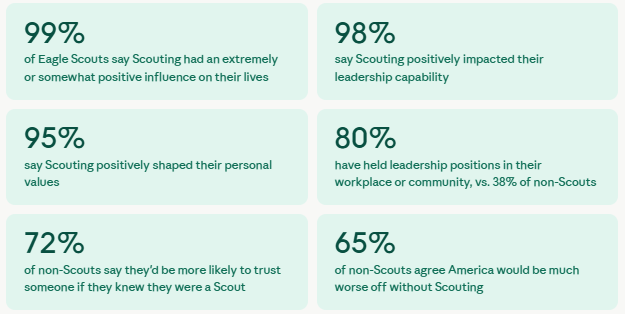
The most telling data point in the entire study may be this one: 72% of people who have never been in Scouting say they would be more inclined to trust someone if they knew that person was a Scout. The program's reputation precedes itself through the behavior of the people it has produced over more than a century.
If you are a family considering Scouting, the research is worth reading in full. The links are below. If you want to see what the program looks like in practice, Troop 478 is worth a visit.