No tents: an overnight at Guice Ranch
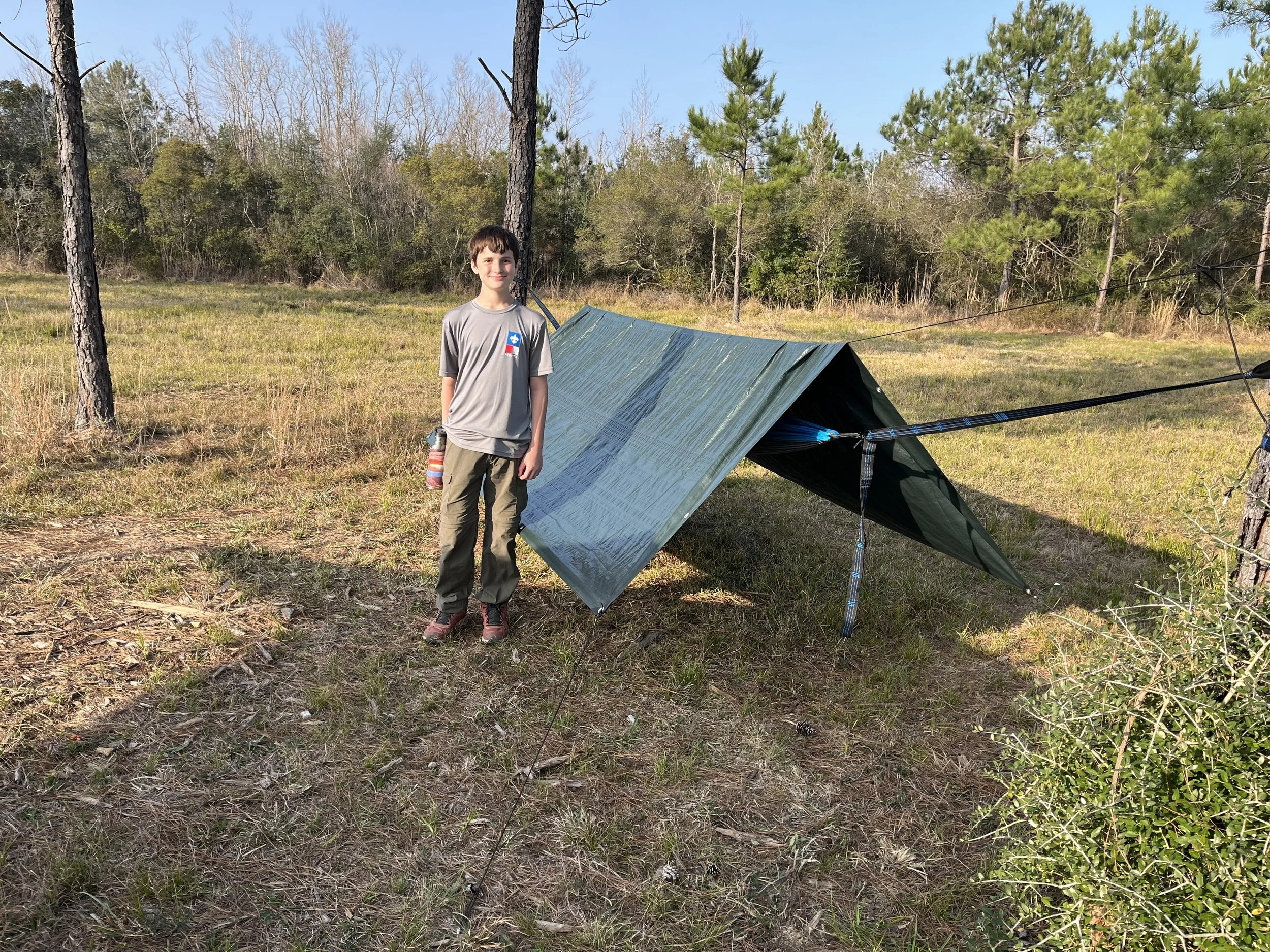
On February 21–22, Troop 478 headed to Assistant Scoutmaster Guice's private ranch for an overnight with a simple rule: no tents. You build what you sleep under.
The setup
Each Scout was issued a tarp, some paracord, and some light coaching to figure it out. The tools in play were knots they had already been introduced to through early First Class Emphasis rank and used on other campouts to erect their Patrol dining fly. Nothing exotic, nothing they hadn't seen before, but the difference was context. There is a significant gap between tying a knot in a meeting room because it's on the requirements list and tying one in the dark because your shelter depends on it.
Scouts improvised stakes from sticks found on the property. Ridge lines went up. Sides got staked out. Some shelters were tight and weather-worthy. Some were architectural experiments that required revision. All of them stood through the night, which was the only standard that mattered.
What was actually being tested
The knots a Scout learns in the first couple of years of the program are not trivia. They are a small library of mechanical solutions to real problems — problems like how to hang something between two fixed points, how to cinch a line that needs to stay tight under load, how to secure a corner that will get pulled on overnight. When those solutions live only on an advancement worksheet, they are knowledge. When a Scout applies them under field conditions to build something he is going to sleep under, they become capability.
That is the distinction this trip was designed to create. The skills were not new. The application was. And application under the real conditions of cold ground, fading light, and repurposing skills in a different context is how knowledge becomes something you can actually count on.
Every Scout who woke up dry on February 22nd had proof of something that no checklist can give him: he can build his own shelter. That is not a small thing.
Why Scouting builds skills this way
Scouting America's advancement program is structured around a core idea that skills are introduced, practiced, and then demonstrated under conditions that require them to actually work. The progression from learning a skill to using it in a controlled setting to applying it independently in the field is not accidental. It is the architecture of how the program builds confidence.
Confidence built through demonstrated competence is durable in a way that encouragement alone is not. A Scout who has been told he is capable and a Scout who has slept under a shelter he built with his own hands are not in the same position. The second Scout knows something the first one only suspects. That gap closes over years of exactly this kind of programming.
The no-tent overnight at the ranch was one evening. The confidence it built is the kind that travels.